Geopolitical Scenarios around Lake Chad by 2050
As part of the preparation for a Conference of the Parties (COP), WWF commissioned CASSINI to conduct a prospective exercise on the geopolitical evolution of the Lake Chad region by 2050.
The study was based on a central parameter: the evolution of the lake's water level according to different climate projections. Based on four possible trajectories — from a lake at its maximum level to near-complete desiccation — CASSINI analysed the territorial, economic, and security consequences for the states and riparian populations.
Lake Chad is a vital space for several countries (Chad, Niger, Nigeria, Cameroon) and for millions of people who depend on its resources for agriculture, fishing, and pastoralism. Its hydrological evolution directly influences local economic balances, migratory dynamics, and security tensions.
In a region marked by institutional fragility and the presence of armed groups, particularly jihadists, the climate issue cannot be separated from geopolitical stakes. The objective was therefore to imagine the political, social, and security consequences of the various climate trajectories envisaged.

The climate scenarios were established from specialised scientific work. CASSINI then constructed four geopolitical trajectories corresponding to these hydrological hypotheses: a lake at its maximum level; a largely dried-up lake; two intermediate scenarios.
For each, a multi-level analysis was conducted:
- agricultural and pastoral dynamics,
- territorial recompositions, demographic pressures,
- competition for access to resources,
- population mobility and impact on security balances.
The study also incorporated a historical reading of the region in order to identify precedents and avoid a linear approach to climate effects.
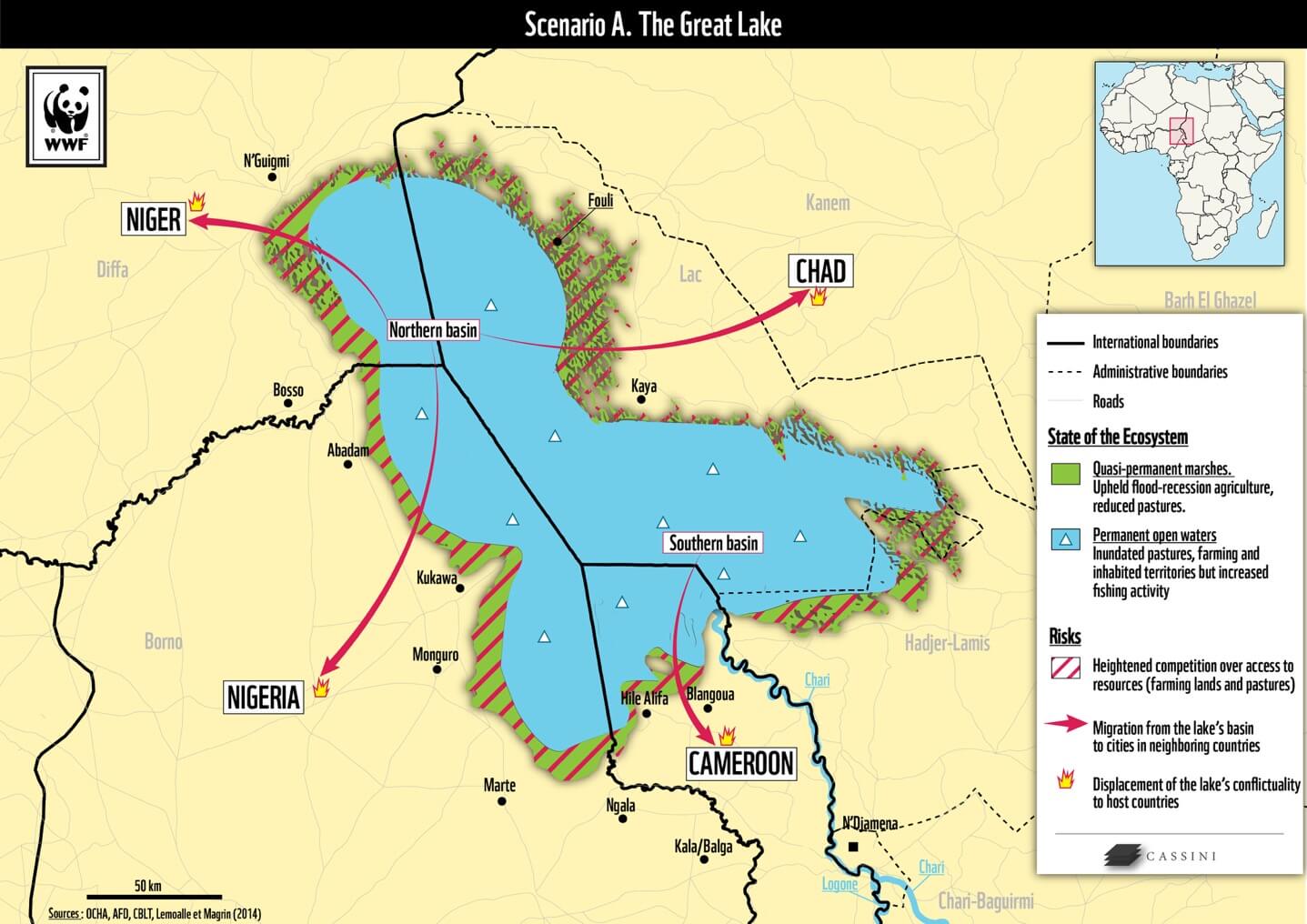
The analysis revealed sometimes counter-intuitive effects. While a full lake may appear to be good news for a desert region, historical experience shows that an intermediate level often favours agricultural and pastoral activities more, thanks to the exploitation of wetlands.
Conversely, a lake at its maximum level can reduce exploitable surfaces, displace populations, and generate new local tensions.
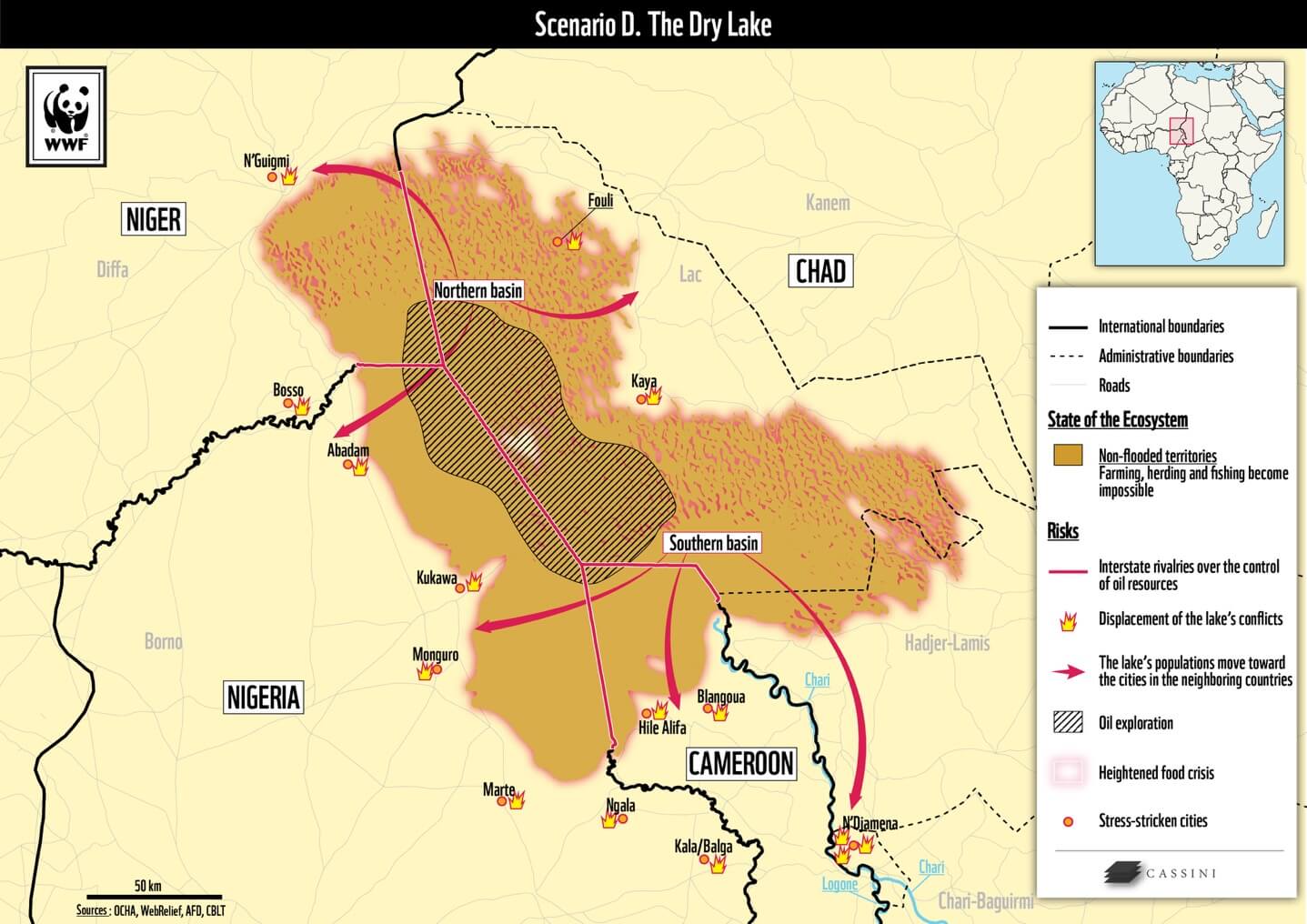
Similarly, significant desiccation does not only produce humanitarian crises: it modifies territorial balances, favours certain mobilities, and can redefine the zones of influence of armed groups.
Each climate trajectory thus induces distinct geopolitical recompositions, affecting regional stability and security policies.


The maps and scenarios presented captured the attention of decision-makers by highlighting the direct links between climate change and geopolitical dynamics.
The study helped shift the debate: climate is not merely an environmental issue, but a structural factor shaping power relations, security vulnerabilities, and regional political trajectories.
This project illustrates CASSINI's capacity to articulate climate foresight and geopolitical analysis in order to inform decision-makers about complex situations where environmental variables redraw strategic balances.