Anticipating Geopolitical Risks Affecting Maritime Routes in the Red Sea
Following the attacks of 7 October 2023 and the extension of the conflict in the Middle East, a major maritime shipping operator engaged CASSINI to anticipate the evolution of tensions in the Red Sea and their consequences for its operations.
The objective was to assess the durability of the disruptions affecting the strategic Bab el-Mandeb strait, to identify the factors likely to alter their intensity, and to propose forward-looking scenarios enabling the company to adapt its commercial and logistical strategy.
The attacks carried out by the Houthis in Yemen against vessels transiting the Red Sea have profoundly disrupted international maritime trade. The massive rerouting of shipping flows via the Cape of Good Hope has led to a significant increase in transport costs, a rise in insurance premiums, and cascading delays across entire supply chains.
For the client, the impact was immediate: margin pressure, contract renegotiations, uncertainty over delivery timelines, and increased pressure from end customers. The crisis had moved beyond a purely geopolitical risk and was becoming a strategic challenge affecting the company's planning, cash flow, and competitiveness.
In this context, the challenge was not merely to understand the immediate situation, but to anticipate its possible trajectories: was this a temporary crisis or a lasting reconfiguration of maritime routes and global economic balances?
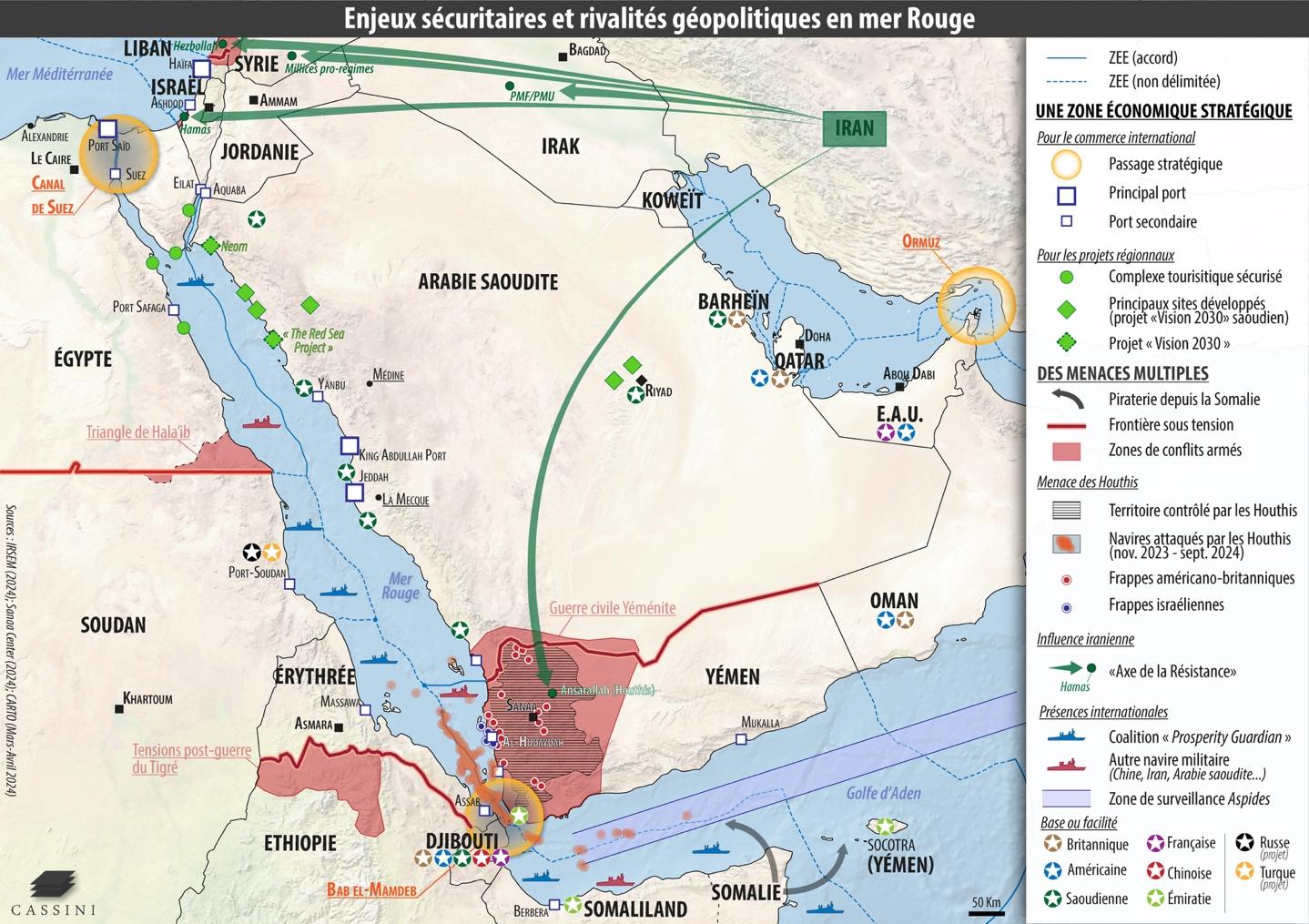
The assignment began with an in-depth geopolitical and cartographic analysis of the area:
- assessment of regional balances of power;
- identification of the role of state and non-state actors;
- mapping of Western powers' positions;
- assessment of the strategic importance of the Bab el-Mandeb strait;
- measurement of the vulnerability of maritime infrastructure.
This analytical phase made it possible to identify the structural variables driving the crisis. Based on these variables, CASSINI developed several forward-looking scenarios:
- gradual stabilisation under enhanced international protection;
- persistence of low-intensity conflict;
- regional escalation of the conflict;
- de-escalation linked to a lasting ceasefire.
Each scenario was accompanied by key indicators to guide the analysis over time: evolution of diplomatic positions, intensity of strikes, US electoral dynamics, regional negotiations, and reactions from economic actors.

Beyond a situational analysis, the company gained a genuine strategic decision-support tool. The anticipation framework provided enabled the assessment of the relative probability of different scenarios, the identification of tipping points likely to accelerate or slow the crisis, and the corresponding adaptation of route planning, capacity management, and contractual strategy.
By transforming a major geopolitical uncertainty into a structured projection framework, CASSINI enabled the client to secure its decisions, limit its financial exposure, and strengthen its resilience in the face of an unstable international environment.