Dynamic Mapping of European Investments in Biotechnology
As part of a strategic seminar organised by BeBarlet, a Spanish public affairs consultancy, focused on European investments in biotechnology, CASSINI was called upon to produce maps with high analytical and educational value.
The objective was to decode a highly technical sector, clarify the dynamics of global competition, and structure a strategic message for the key Spanish and European players in the sector.
The biotechnology sector is characterised by intense global competition, complex value chains, and significant gaps between scientific, technological, and financial capabilities.
For BeBarlet, the challenge was not merely to present data, but to surface a clear diagnosis: where does Europe stand in global competition? What are its strengths? Which countries have the structural capacity to assert themselves? What weak signals point to new growth dynamics?
The challenge lay in the technical density of the information and the need to make it intelligible and strategically impactful during a public presentation.
CASSINI designed two complementary maps.
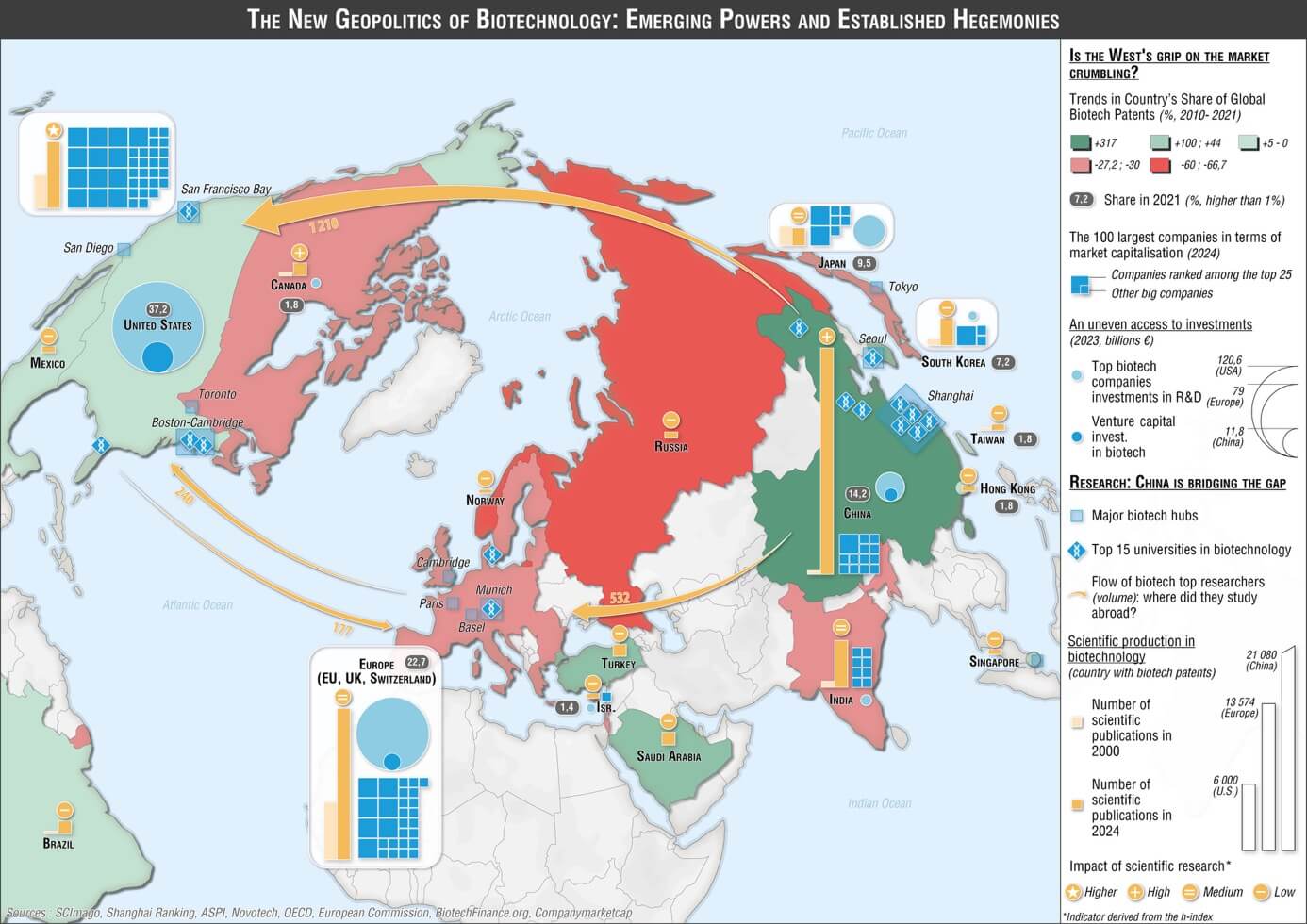
The first offered a global panorama of rivalries in biotechnology. It highlighted the gaps between major powers in terms of scientific publications, technological capabilities, investment volumes, and strategic positioning. This map allowed Europe to be placed within a global competitive environment dominated by a few major players.

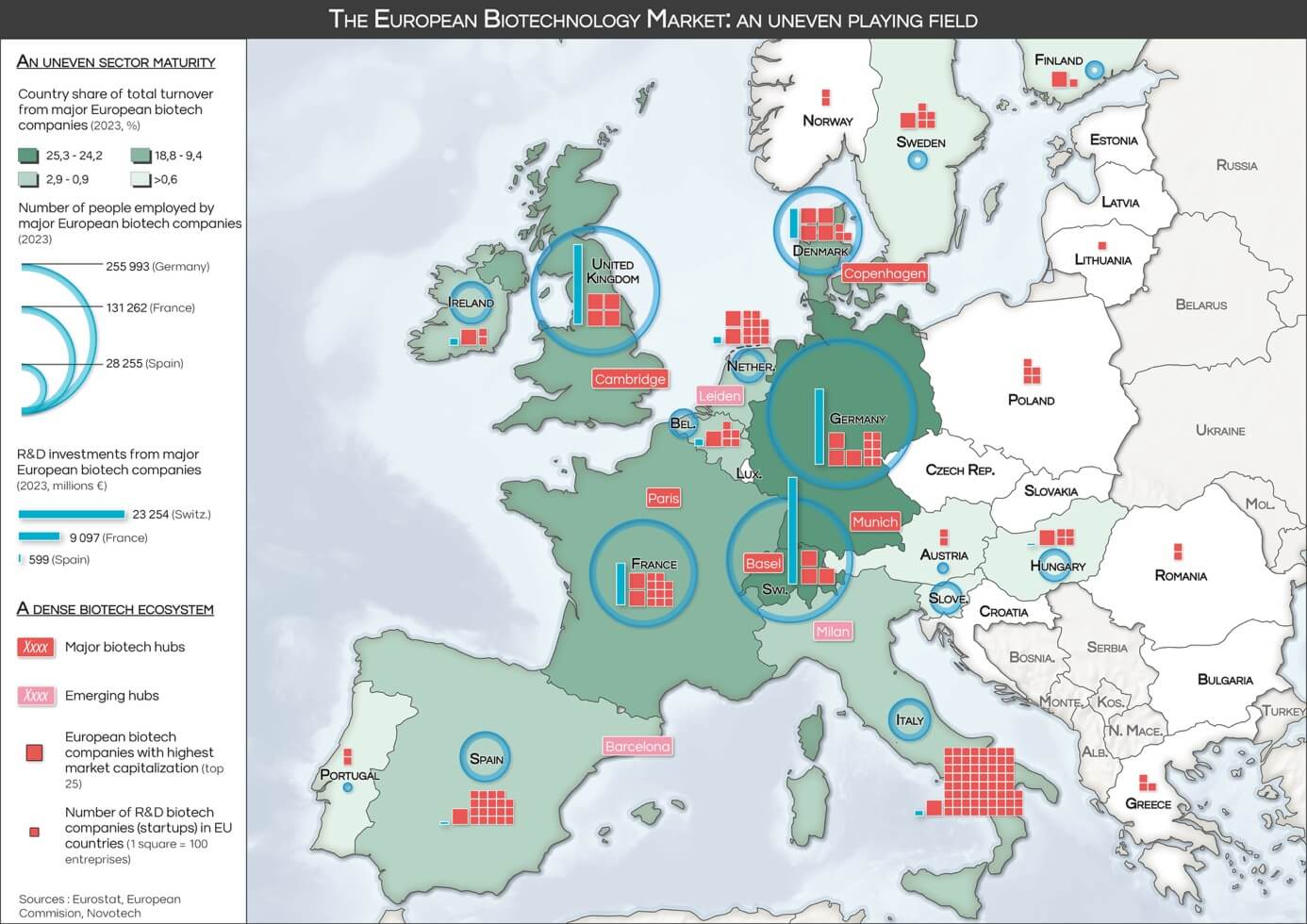
The second map offered a focus on the European space. It cross-referenced structural variables (employment, capitalisation, innovation capacity) to identify the strongest clusters. It also highlighted the technological dynamism of certain less advanced countries, identified as carrying weak signals of future growth.

Given the complexity and technical nature of the data, CASSINI proposed a scripted cartographic presentation. Rather than a static projection, the presentation was designed as a progressive demonstration. The layers of information (global rivalries, European positioning, structural variables, weak signals) were revealed successively. Each visual sequence introduced a new level of reading, guiding the audience from a broad observation to a nuanced understanding of European challenges.
This controlled progression maintained the attention of an expert audience, avoided information overload, and transformed the map into a genuine communication tool. The presentation was no longer a simple data display, but a visual narrative of power dynamics and opportunities, capable of making a lasting impression.
The dynamic maps enabled BeBarlet to position itself not only as an organiser of debate, but as a structuring actor in strategic thinking on biotechnology in Europe. By providing a clear and hierarchical reading of global rivalries, the consultancy strengthened its credibility with the industrialists, investors, and public decision-makers in attendance.
The mapping tool served as a genuine differentiating factor for this public affairs consultancy, demonstrating their ability to objectify debates, structure a strategic agenda, and support a positioning with visually demonstrative data.
The subsequent dissemination of the content by Agenda Pública, a specialised Spanish media outlet, extended this dynamic by placing the debate in the media space, broadening the audience and consolidating the client's visibility.
This project illustrates CASSINI's ability to design cartographic materials with high influence value, enabling public affairs consultancies to transform complex data into a strategic, reputational, and decision-making lever.